

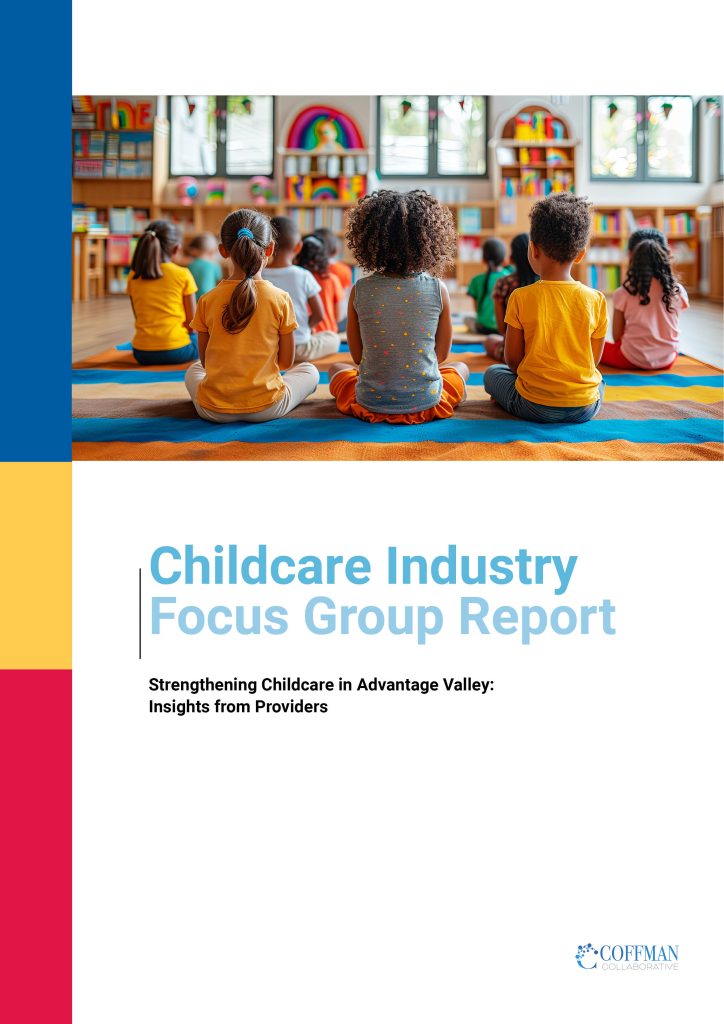
Charleston, WV. April 3, 2025 – A new focus group report from Advantage Valley reveals systemic barriers facing childcare providers across its nine-county region—insights that have directly shaped a new series of free childcare business workshops launching this spring. The report, based on interviews and survey responses from 23 providers, highlights challenges like outdated state reimbursement systems, staffing shortages, and increased behavioral health needs among children—issues the workshops aim to address through business coaching, microgrant access, and hands-on support.
“Childcare is workforce infrastructure. The providers we spoke with are essential to economic growth in West Virginia, but they are overwhelmed, under-resourced, and often navigating a system that works against them,” said Terrell Ellis, President of Advantage Valley. “This data gives us a clear foundation to understand the business challenges these providers are facing, and it allows us to better tailor our services—whether through business coaching or connecting them to grant resources that can make a real difference.”
Childcare providers across the Advantage Valley region said one of the most pressing issues they face is the outdated, paper-based system the state of West Virginia uses to process subsidized childcare reimbursements. Providers are still required to submit forms by mail, often encountering significant delays and errors that lead to late payments and strained cash flow. These delays can be catastrophic for small centers and family care homes, many of which rely on timely reimbursements to make payroll and purchase basic supplies.
“Inflation, rising operational costs, and continued uncertainty around how providers are reimbursed make it incredibly difficult for centers to plan long-term,” said Ellis. “As a result, many are operating well below capacity, even though thousands of families across our region still don’t have access to the childcare they need.”
Staffing shortages remain a critical barrier. Providers say they can’t compete with retail and fast food employers that offer similar wages without the high demands of childcare work. Compounding the issue is a rise in behavioral challenges among children since the pandemic, which has placed additional strain on already under-resourced staff. Many providers expressed frustration over the lack of access to training and behavioral health support, factors that contribute to high turnover and burnout.
Other challenges identified in the report by providers:
- Behavioral Health Concerns: Providers across the board report a sharp rise in behavioral issues among children since the pandemic, with limited training or support available to staff navigating these changes.
- Capacity Struggles and Financial Uncertainty: While nearly one-third of children in the Advantage Valley region lack access to childcare, many centers remain under-enrolled due to insufficient staff and unreliable cash flow from delayed reimbursements.
- Hidden Costs of Hiring: Providers are now spending more on advertising open positions—an expense that didn’t historically exist for many centers. These added costs often come at the expense of educational supplies or facility maintenance.
- Need for Small-Scale Support: Many providers requested micro-grants for everyday essentials—snacks, STEM materials, diapers, and classroom supplies—not large infrastructure investments.
- Grant Eligibility Confusion for Church-based Centers: Some church-affiliated providers reported difficulty determining which grants they are eligible for, particularly during transitions in nonprofit status. Changes in classification can affect access to certain funding opportunities, creating uncertainty and limiting their ability to pursue financial support.
- Nonprofit Status Limitations: As some church-based centers transition from secular to faith-based affiliations, they may no longer qualify under certain 501(c)(3) exemptions, which can restrict access to funding and resources typically available to nonprofit childcare providers.
The Advantage Valley region is already experiencing a shortage of more than 5,000 childcare slots—an issue that exacerbates an already urgent workforce challenge in a state ranked 50th in childcare accessibility. To help address the gaps identified in this report, Advantage Valley is hosting a series of free childcare business workshops across the region through its FASTER WV program. These sessions are tailored for individuals interested in starting or expanding a childcare facility—whether home-based or center-based—and offer practical resources, business coaching, and access to microgrant opportunities.
The workshops are supported by grant funding from the Appalachian Regional Commission and feature partners such as the West Virginia Small Business Development Center, Wonderschool, local health departments, State Fire Marshals, the Department of Human Services Division of Early Care and Education, and the childcare resource and referral agencies.
Upcoming events include a Putnam County workshop on April 10 at 6:30 p.m. at Area 34 in Hurricane, and a Kanawha County session on May 6 at 6:30 p.m. at the Connect CCR&R Office in Charleston. For a full list of dates and to register, visit www.advantagevalley.com or to register: https://www.eventbrite.com/o/advantage-valley-55321568063
To view the full report: https://advantagevalley.com/wp-content/uploads/2025/04/AV-FocusGroup-Report-FINAL.pdf
####
Advantage Valley, Inc. is a regional economic development organization whose mission is to grow economic opportunity in the Charleston-Huntington Metro Area by increasing investment in the region, leveraging resources, and building collaboration among community stakeholders.